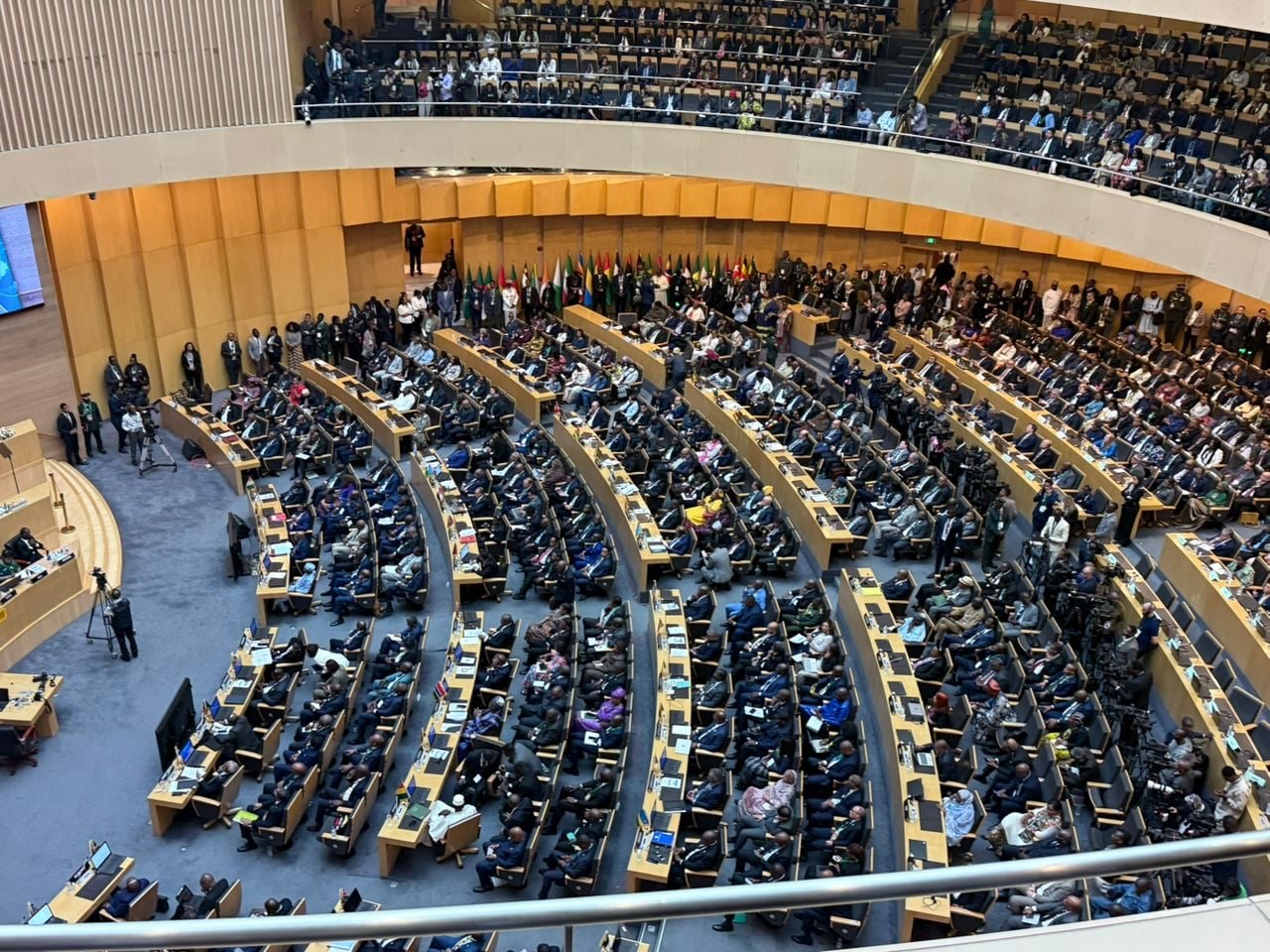
African leaders also united in pressing for health sovereignty and greater equity in their engagement with Western nations, while acknowledging the need for internal reforms to transform the AU from a forum of commitments into an institution of concrete action.
Here are five key takeaways from the summit.
WATER SUSTAINABILITY WAS THE CENTRAL THEME — BUT SECURITY DOMINATED TALKS
AU HQ in Addis Ababa, Ethiopia
The two-day summit was held under the theme ‘Assuring sustainable water availability and safe sanitation systems to achieve the goals of Agenda 2063’.
Mahmoud Youssouf, chairperson of the AU commission, framed water as a vital collective resource that must be preserved amid climate change and leveraged as a tool for peace and cooperation among member states.
Ahead of the summit, TheCable predicted that while the theme was strategic to proving Africa’s commitment to tackling environmental issues, peace and political stability were likely to overshadow the formal theme, especially as armed attacks continue to test the commission’s conflict-management architecture.
In a press conference closing the summit, Youssouf acknowledged that most of the deliberations revolved around peace and security on the continent.
He said heads of state were determined to ensure the realisation of the ‘Silencing the Guns in Africa’ agenda — a flagship initiative of the African Union Agenda 2063 that aspires to end all wars, conflicts, and gender-based violence and to prevent genocide by 2030.
Bankole Adeoye, AU commissioner for political affairs, peace, and security, also noted that the multilateral peace and security council (PSC) is committed to ensuring it fulfills its mandate.
Adeoye noted the PSC’s concerns about ongoing conflicts across the continent and also noted that an objective of the AU is to see “a continent that is at peace with itself and at peace with the world”.
At the summit’s opening session, Meloni announced Italy’s launch of a debt-cancellation programme for African countries. Her announcement drew applause from African leaders.
She noted that the debts of “the most fragile and vulnerable countries” would be converted into investments and strengthen their contributions to the World Bank’s IDA funds. But the Italian prime minister did not give details on the mechanisms of this new programme.
African leaders have long pushed for debt cancellations from wealthier countries, arguing that their fiscal distress cannot be divorced from histories of exploitation, financial injustice, and structural inequalities.
Meloni’s intervention landed at a politically opportune moment, allowing her to align Italy with longstanding African demands while subtly advancing Rome’s own strategic interests.
Migration from Africa to Italy remains one of the most pressing domestic and foreign policy challenges for her government.
Italy sits on the front line of Mediterranean crossings, with thousands of migrants departing from North African shores each year in attempts to reach Europe.
Since taking office, Meloni has prioritised curbing irregular arrivals through bilateral agreements with transit countries, tighter border controls, and renewed cooperation with African governments aimed at addressing the root causes of migration, including instability and economic distress.
Meloni spoke of how Italy intends to continue to be a privileged bridge between Europe and Africa, making available the strength of its institutions, its great tradition of dialogue, and the expertise of its companies.
“To achieve this, we want to… guarantee the men and women of this continent a freedom that has often been denied them: the freedom to choose to remain in their country, to contribute to its growth without being forced to leave it, often paying unscrupulous traffickers to risk their lives in an attempt to cross the Mediterranean,” she said.
Meloni said the plan was aimed at multiplying talents and building a model of development that respects people and values different identities.
Youssouf: Without reforming the way we’re handling our security issues, the way we’re handling our economic challenges and trade-related affairs, I think it will be very difficult to reach the deliverables that we need
Though security dominated the central theme of water sustainability, the reason for convergence was not ignored.
In his address, Guterres acknowledged the need for climate action. The UN secretary-general noted Africa’s potential to become a “clean energy powerhouse”, noting that the continent is home to 60 percent of the world’s best solar potential.
“Yet Africa receives only two per cent of global clean energy investment. After contributing almost nothing to the crisis, Africa faces faster-than-average warming. Adaptation must be a priority,” he said.
“That requires developed countries tripling adaptation finance and mobilising the $1.3 trillion a year for developing countries by 2035, as agreed in Baku; scaling up the loss and damage fund; accelerating a just, orderly, and equitable transition from fossil fuels to renewables; and expanding early warning systems.”
Kenyan President William Ruto urged African leaders to place climate priorities at the centre of economic planning and investment decisions.
On the sidelines, experts, policymakers, and business groups encouraged the AU to move from declarations to structural reforms on financing, green industrialisation, and economic sovereignty, and urged the commission to shift toward stronger continental economic systems prioritising water security, climate resilience, infrastructure, and value addition in energy and critical minerals.
Shettima: Capital market will drive industrialisation, improve citizens’ living standards
In choosing cooperation, we built a continent that could heal itself
Leaders stressed the need to reduce dependence on foreign grants and external supply chains, arguing that Africa must build resilient health systems capable of responding swiftly to disease outbreaks without being exposed to global disruptions.
Vice-President Kashim Shettima reiterated this stance in a side event. He said Nigeria is ready to work with AU member states to make health security sovereignty measurable in factories commissioned, laboratories accredited, health workers trained, counterfeit markets dismantled, and insurance coverage expanded.
“A virus, as we have witnessed, does not carry a passport. A counterfeit medicine does not respect a border. A pandemic does not wait for
bureaucracy,” Shettima said.
In a separate address, Youssouf described Africa’s health security as “a big challenge for the continent”.
The AUC chairperson noted that deliberations focused on how best African leaders can strengthen their countries’ health structures.
African ministers called for the prioritisation of human resources for health and community health workers as strategic pillars of primary health care, universal health coverage, and pandemic prevention, preparedness, and response.
They also called for accelerated progress toward the continental target of two million community health workers by 2030 and increased and sustained domestic financing for the health workforce and community health systems.
Internal reforms have long been a topic among AU leaders.
In a closed committee meeting, Shettima criticised the institution for not effectively overseeing the operationalisation of South Sudan’s peace agreement.
Slow decision-making, limited enforcement mechanisms, and uneven follow-through on commitments have been cited as roadblocks that undermine the translation of policy frameworks into tangible outcomes across the continent.
Ruto, the designated AU champion for institutional reform, presented a report proposing revisions to the multilateral structures.
The Kenyan president spoke of preventive action, collaboration, and the use of emerging technologies as practical measures to strengthen peace, security, and governance.
He also proposed scaling up the peace fund from $400 million to $1 billion, strengthening preventive diplomacy and mediation, closing the early warning and response gaps, reinforcing norms against unconstitutional changes of government, and revitalising Pan-African solidarity.
“These reforms are necessary for silencing the guns, attracting investments, and enabling African states to deliver justice to their citizens,” he said.
In the closing session, Youssouf acknowledged that the AU leaders deliberated on the proposed reforms.
He said efforts would be put in place to strengthen the organisation. That remains to be seen.