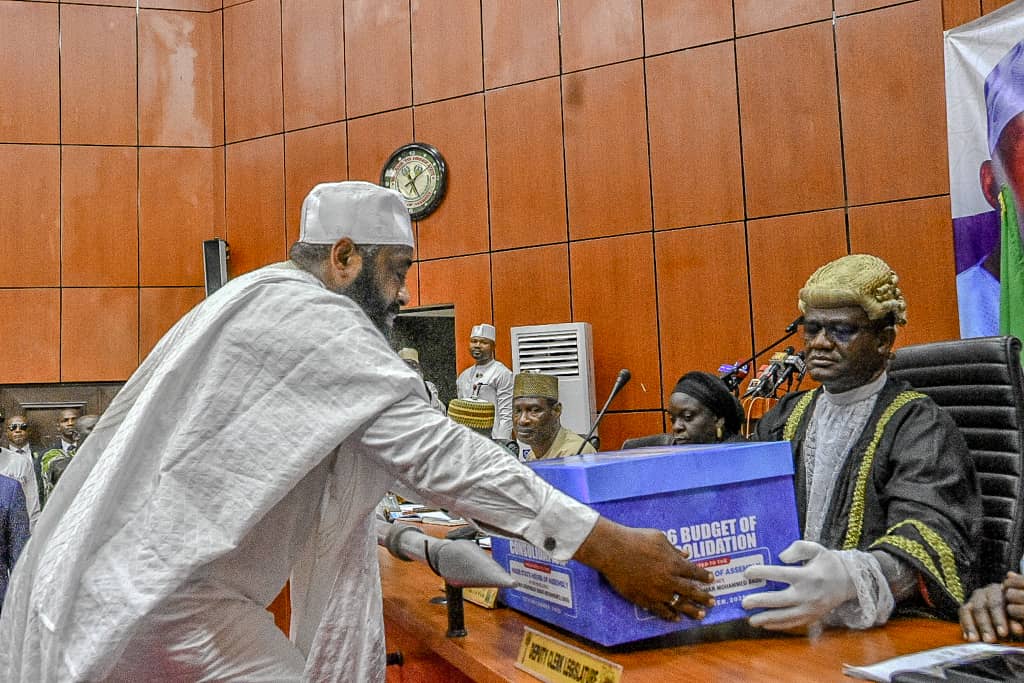
Governor Umaru Bago of Niger ,on Friday, presented a N1.31trillion budget for the 2026 fiscal year, describing it as a financial plan anchored on consolidation, growth and sustainability.
Mr Bago said the budget titled “Budget of Consolidation,” would focus on strategic priority areas such as wealth and job creation, agricultural transformation, healthcare strengthening, road infrastructure and education improvement.
He said the budget comprised N270.29 billion or 26.19 per cent for recurrent expenditure and N761.64 billion or 73.81 per cent for capital projects.
He said revenue for the fiscal year would be sourced from statutory allocation of N163.2 billion, Value Added Tax of N154.7 billion, internally generated revenue N100.2billion and capital receipts N398.8 billion.
He said key sectors would receive substantial allocations such as agriculture N59.2 billion, education N107.9 billion, health N72. billion and infrastructure would take the entire capital vote of N761.6billion.
In the agricultural sector, the governor said the state plans to channel funds into fertiliser distribution, construction of abattoirs and the establishment of an Agricultural Cooperative Agency to support productivity and value-chain expansion.
He said the education sector’s N107.9 billion vote would be used to overhaul 325 schools, train teachers, and promote vocational skills development in agriculture and ICT for young people.
He said the health sector’s N72 billion allocation would support the drive for universal health coverage, completion of Primary Healthcare Centres (PHCs) and implementation of state health insurance schemes.
Mr Bago said infrastructure spending would focus on road construction, water supply expansion and energy projects aimed at strengthening economic activities across the state.
He further disclosed that the economic sector would receive N510.3 billion for agriculture, commerce and industrial development, while the social sector would take N194.1billion for education, health and social welfare interventions.
He said the law and justice sector would receive N7.8 billion to strengthen the justice system and enhance the rule of law, while general administration was allocated N50.3 billion for civil service reforms and improved public service efficiency.
He noted that the budget was predicated on an exchange rate of N1,447.21 per dollar, inflation rate of 16.05 per cent and GDP growth projection of 4.23 per cent.
He said implementation of the 2026 budget would prioritise completion of ongoing projects, agricultural development, food security, and enhancement of internal revenue generation to reduce dependence on federal allocations.
In his remarks, Abdulmalik Sarkin-Daji, Speaker of Niger House Assembly, reaffirmed the legislature’s support for the state government and called for sustained collaboration to advance the vision of a prosperous and secure “New Niger”.
He said the progress of the state depended on stronger synergy among the executive and legislature, government and traditional institutions, and between leaders and citizens.
He said such unity was essential to building a Niger that is prosperous, secure, globally competitive and full of opportunities.
(NAN)