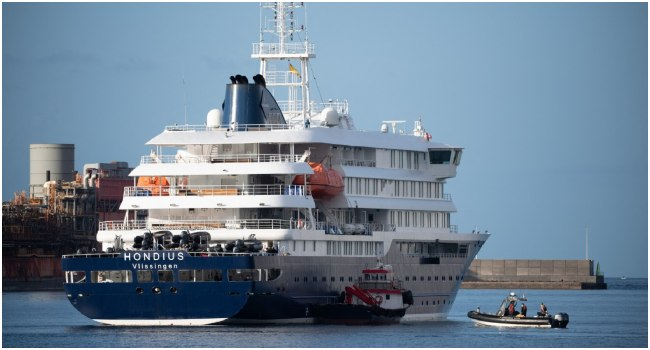
Boats approach the Dutch flagged hantavirus-stricken cruise ship MV Hondius after it arrived at the industrial port of Granadilla de Abona on the island of Tenerife in Spain’s Canary Islands on May 10, 2026
A cruise ship hit with a deadly hantavirus outbreak arrived in Spain’s Canary Islands on Sunday, where most of the nearly 150 people on board will be evacuated and flown home after weeks at sea.
The Dutch-flagged MV Hondius arrived at the Spanish port of Granadilla escorted by a Civil Guard vessel, AFP journalists reported, confirmed by data from the maritime tracking service VesselFinder.
Passengers and some of the crew are expected to evacuate before the ship, where an outbreak of hantavirus led to the deaths of three people, continues on its way to the Netherlands.
Three passengers from the ship — a Dutch husband and wife and a German woman — have died, while others have fallen sick with the rare disease, which usually spreads among rodents.
The only hantavirus type that can transmit from person to person — the Andes virus — has been confirmed among those who have tested positive, fuelling international concern.
The plane to be used to repatriate Dutch and other nationals stands idle at the Tenerife Sur-Reina Sofia airport, awaiting evacuees from the Dutch-flagged hantavirus-stricken cruise ship MV Hondius, which arrived at the industrial port of Granadilla de Abona on the island of Tenerife in Spain’s Canary Islands on May 10, 2026
“We classify everybody on board as what we call a high-risk contact,” WHO’s epidemic and pandemic preparedness and prevention director Maria Van Kerkhove said Saturday.
But the risk to the general public and the people of the Canaries remained low, she added.
WHO chief Tedros Adhanom Ghebreyesus, who arrived in Spain on Saturday and is expected to oversee the ship evacuation, gave the same assurance and thanked the people of Tenerife for their solidarity.
“I need you to hear me clearly,” Tedros wrote in an open letter to the people of Tenerife on Saturday: “This is not another Covid.”
After arriving in Tenerife, he said he was confident the operation would be a success. “Spain is ready and prepared,” he told reporters.
– Daily life uninterrupted –
A civil guard boat patrols before evacuation operations on the Dutch-flagged hantavirus-stricken cruise ship MV Hondius at the industrial port of Granadilla de Abona on the island of Tenerife in Spain’s Canary Islands on May 10, 2026
At the port of Granadilla de Abona early Sunday morning, AFP journalists saw white tents had been sent up along the quay and the police had secured part of the port.
Despite the situation, daily life appeared largely normal: some people were swimming, others shopping at the market or sitting at cafe terraces.
“There are worries there could be a danger, but honestly, I don’t see people being very concerned,” said David Parada, a lottery vendor.
Regional authorities have refused to allow the vessel to dock. Instead, it will remain offshore while passengers are screened and evacuated between Sunday and Monday — the only window health officials say the weather will allow.
Cruise operator Oceanwide Expeditions said earlier that “all guests and a limited number of crew members” were expected to begin to leave the ship from around 0700 GMT.
“Once disembarked, they will be transferred immediately to their allocated aircraft,” the Dutch firm said.
The WHO said Friday it had confirmed six cases out of eight suspected ones. There are no suspected cases remaining on the ship.
The MV Hondius is sailing from Cape Verde, where three infected people had already been evacuated earlier in the week.
– Tracking and tracing –
Spanish civil guard members wear protective suits as the Dutch-flagged hantavirus-stricken cruise ship MV Hondius arrived at the industrial port of Granadilla de Abona on the island of Tenerife in Spain’s Canary Islands on May 10, 2026
In Madrid, Spain’s health and interior ministers insisted there would be “no contact” with the local population, and that passengers would leave “by nationality groups”.
“All areas (the passengers) pass through will be sealed off,” the interior minister said, adding a maritime exclusion zone would be in force around the vessel.
The MV Hondius left Ushuaia, Argentina on April 1 for a cruise across the Atlantic Ocean to Cape Verde.
Provincial health official Juan Petrina said there was an “almost zero chance” the Dutch man linked to the outbreak contracted the disease in Ushuaia based on the virus’s incubation period, among other factors.
Health authorities in several countries have been tracking passengers who had already disembarked and anyone who may have come into contact with them.
A flight attendant on the Dutch airline KLM, who came into contact with an infected passenger from the cruise ship and later showed mild symptoms, tested negative for hantavirus, the WHO said Friday.
The passenger — the wife of the first person to die in the outbreak — had briefly been on a plane bound from Johannesburg to the Netherlands on April 25, but was removed before take-off.
She died the following day in a Johannesburg hospital.
Spanish authorities said a woman on that flight was being tested for hantavirus, having developed symptoms at home in eastern Spain. She is in isolation in the hospital, said health secretary Javier Padilla.
Two Singapore residents who had been on the ship tested negative for the disease but would remain in quarantine, the city-state’s authorities said Friday.
British health authorities also said Friday there was a suspected case on Tristan da Cunha, one of the world’s most isolated settlements with around 220 people.